|
|
|
Ethiopian perspective on Rastafarians |
|
|
|
|
|
|
Ethiopia (also known Historically as Abyssinia)
is located in northeast Africa. |
|
Ethiopians trace their history into the Biblical
era. |
|
Ge’ez is the original language echoed in Amharic
and Tigregna |
|
|
|
|
1960 – Draught resulting in Famine |
|
1974 Revolution |
|
1977 – 80 Red Terror |
|
1975 – War with Eritrea, Tigray and Somalia |
|
|
|
|
|
|
Remnants of Ethiopia’s Rich History are found
mostly in the regions of Tigray, Gonder, Lasta and Wello |
|
|
|
|
|
|
|
|
The oldest city in Ethiopia founded 300-100 B.C |
|
The city was destroyed by the Islamic invasion
in Fifth century |
|
|
|
|
Christianity was introduced around A.D. 325 |
|
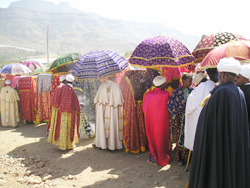
Ethiopian Orthodoxy embraces the Monophysite
doctrine,and differs from other Orthodox Christianity |
|
Hebraic influences are evident in linguistic,
religious ritual and customs |
|
Islam makes up the largest religious group. |
|
|
|
|
Ethiopic Bible |
|
Kebre Negest – Story of Queen of Sheba and King
Solomon |
|
Book of Enoch |
|
Book of Pearl |
|
Zena Aylmud (History of the Jews |
|
Lamentations of St. May |
|
|
|
|
|
|
|
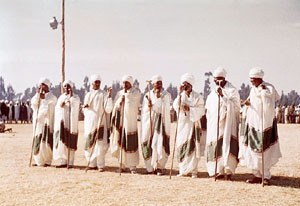
“The liturgical chant accompanied by the sound
of cestrum and the rhythmical beat of the drums and prayer sticks all have
a keen similarity to worship in the
Old Testaments” (Edward Ullendorff ) |
|
|
|
|
Paganism is widely practiced in Ethiopia |
|
Belief in the spirits includes the Adbar
(ancestral spirit) the Zar (a malevolent entity) and the buda (the evil
eye) |
|
|
|
|
|
|
The four major Ethnic groups are: Amhara, Tigray
and Oromo |
|
Majority of Ethiopians are Oromo however power
has always been maintained by the Amhara. |
|
There are over 70 spoken languages in Ethiopia. |
|
|
|
|
Named for the Young Ras Teferi – |
|
Ethiopia is the Holy Land (new Zion) |
|
Emperor Haile-Sellassie I is considered the
redeemer |
|
The Kebre-Negest is the Black man’s Bible |
|
|
|
|
|
|
|
|
A devote Christian the Emperor did not agree
with the claim that he is ‘Jah’ (God) |
|
He invited Rastafarians to repatriate to
Ethiopia |
|
He sent Clergy to Jamaica to convert rastas into
Christians |
|
|
|
|
Jamaican born political activist and charismatic
speaker. |
|
His aim was to mobilize African Americans to
advocate against Colonialism and racism in Africa and throughout the
Western World |
|
He is credited for the slogans “Back to Africa
our homeland” . |
|
He saw Ethiopia as the model for future Africa,
and Haile-Sellassie a model for the black man. |
|
|
|
|
|
“Back to our homeland” |
|
|
|
“Look to Africa for the crowning of a Black
King…” |
|
|
|
“Greetings form Ethiopians in the Western
World…” |
|
|
|
|
|
|
Three leaders in union with the the ten
commandments in the background |
|
|
|
|
Ethiopian Iconography (St George) with a
Rastafari message |
|
Ganja (the holy herb) the Ethiopian colors |
|
|
|
|
|
|
|
|
|
|
Even after the Emperor’s death in 1975 the
Rastafarian faith is still strong. |
|
Rastafari and their link with Ethiopia can be
described as a process of cultural
/spiritual borrowing. |
|
In light of this strong link what are their
relationship? |
|
|
|
|
Archbishop Yesehaq 1989 The Ethiopians |
|
Bastide, Roger African Civilization in the New
World |
|
Bourdieu, Pierre 1998 Practical Reason |
|
Chevannes,Barry 1994 Rastafari:Roots and
Ideology |
|
Haile-Sellassie I. My life and Ethiopia’s
Progress |
|

 Notes
Notes